

trading strategy for 2 month trading competition
When utmost-frequency trading firms compete, does stock market liquidity deteriorate? I indicate that the resolve is yes. High-frequency trading rival may impact stock grocery store liquidity via two channels. Freshman, more challenger is accompanied by Thomas More high-frequency trading and larger trading volumes, which improve market liquidity. Second, Sir Thomas More competition may mean that high-frequency traders adapt their trading strategies and engage in more unsound trades, which harms market fluidness. Since these two channels have the paired effects on market liquidity, it is important to disentangle the effects of competition from those of a mere step-up in the come/volume of luxuriously-relative frequency trading transactions. In the depth psychology, I aim to do exactly this, by exploitation an exogenous outcome which changed the intensity of high-frequence rival for some stocks but not for others. I find that otherwise similar stocks subject to more high-frequency trading competition suit inferior liquid.
Introduction
High-frequency traders (HFTs) are market participants that are characterised away the high speed with which they react to entrance tidings, the low-altitude stock-take on their books, and the large total of trades they run. All this is achievable for HFTs because they use machine-controlled, algorithmic trading, which enables them to analyse markets and execute trades in under a millisecond. The high-frequency trading diligence grew rapidly later on it took off in the middle-2000s. Now, high-relative frequency trading represents roughly 50% of trading volume in US equity markets. In European equity markets, its share is estimated to be betwixt 24% and 43% of trading mass, and about 58% to 76% of orders.[2]
A characteristic characteristic of the falsetto-frequency industry is fierce competition. As I explain below, some conceptual studies have argued that competition among HFTs may deliver adverse effects on market liquidity. This Research Bulletin provides an medical practice linear perspective and asks: does contention among HFTs touch on commercialise liquid state? If so, finished which channels does the effectuate operate? The answers to these questions figure on the results of a analyze carried unsuccessful by Breckenfelder (2019).
What does the theory recite us about high-oftenness competition and market liquidity?
A commercialize is same to be liquid if thither are many buyers and sellers and transaction costs are low. In the particular encase of a stock exchange, a liquifiable market is characterised by the ability to transact in a stock easily, without causing a prodigious price alteration. There are cardinal major players in any transaction, namely the price-taker (investor) and the market-maker (counterparty). Marketplace-makers post quotes offering to sell stocks at a given price (the "ask" price) and to buy stocks at a granted toll (the "bid" Mary Leontyne Pric). When an investor initiates a switch, she leave accept single of these two prices dependant on whether she wishes to buy or sell the stock certificate (at the ask or bid damage, respectively). The difference between these two, the tender-ask spread, is a frequently used measure of market liquidity. It is also a measure of trading costs. Commercialize-makers pull together the spreads through processing the flow of orders at the adjure and ask prices.
HFTs can choose to act equally market-makers simply, as, they can decide to act as speculators. As commercialize-makers, they can update their terms quotes fast when news arrives and provide liquidity to the commercialise. In this case, the low-frequency traders in the market – the investors – benefit from lower transaction costs. A speculators, however, HFTs can use their swiftness vantage to quickly take the quotes posted by their competitors when news arrives. A the arrival of news makes those quotes out-of-date, HFTs can buoy make money at the disbursement of their competitors (often high-frequency market-makers). Anticipating these losses, market-makers take to raise the bid-ask spread to recoup the increased costs.
Such competitive races between market-makers and malodorous-frequency speculators is what harms market liquidity, A pointed unfashionable by recent theoretical models (Budish, Cramton, and Shim (2015) and Menkveld and Zoican (2017)). Investors end up gainful higher transactions costs – e.g. in the form of higher bid-ask spreads – arsenic a result of high-frequency trading competition.
What do the data evidence us about liquidity effects of utmost-frequency trading contention?
I use a unique dataset that captures the trading of internationally healthy-established large HFTs connected the Stockholm Securities market (SSE), the largest Nordic exchange. The sample distribution consists of NASDAQ/OMXS30 index stocks and runs from June 2009 through January 2010. The data progress to it possible to track the activity of each high-frequency trading firm. Essentially all trading of catalogued securities took place on this single securities market so one can value whether operating theatre non HFTs competed in a particular stock.
I use an exogenic event to tell the personal effects of competition among HFTs from the effects of mere increases in the number of high-frequency transactions in the market. The event is a tick size harmonisation reclaim past the Confederacy of European Securities Exchanges (FESE) implemented on 26 Oct 2009. The tick size is the nominal amount away which the terms of a stock force out move on an exchange. The see the light decreased ticktack sizes for most, but non all of the stocks in the try out, effectively splitting the stocks into three groups.
Aggroup 1 was not touched by the reform because prices of stocks in this mathematical group happened to fall within a certain set out (e.g. SEK 100 to SEK 150, the equivalent of USD 14.70 to USD 22.05). Totally the other stocks, constituting Radical 2 and Group 3, were affected by the reform and experienced a significant decline in tick sizes.
As a result of the rectif, the relative tick size – the tick size relative to the stock monetary value – declined for some stocks to lower levels than for others. I will use these differences in relative check off size decline to split stocks into Grouping 2 and Group 3. I conjecture that the lower the relative ticking size, the more credible HFTs are to enter. Logically, HFTs must weigh up the benefits and costs of submission and the relative tick size is reflective of trading costs per dollar sign/euro invested with. Lower trading costs have two effects happening high-frequency trading entry. First, they make it easier for HFTs to trade so that they can execute big trading volumes. Second, frown tick sizes reduce bid-ask spreads, which reduces profits for market-makers in general, but to a lesser extent so for HFTs repayable to their speed advantage. Some of these effects should lead to more high-frequency trading entry.
For stocks in Group 2 of the sample distribution, the relative tick size of it declined but remained within the range of relative click sizes observed prior to the reform. Therefore, Group 2 stocks are less likely to experience a change in mellow-frequency trading entry because HFTs could have traded with such trading costs already ahead the reform. For Group 3, the remaining stocks, the relative tick size declined to levels unobserved prior to the reform. It is for these stocks that one is most likely to see senior high school-frequency trading entry and more high-frequency trading competition because HFTs would wish to take advantage of these new lower trading costs.
Chart 1 provides a summary of the impact of the reform on relative tick sizes. It illustrates the comparative tick sizes before and after the reform for the trio groups. For Mathematical group 1, the comparative tick size remains idempotent. For Groups 2 and 3, proportionate tick sizes decline after the reform. However, the relative tick of size cadaver to a higher place the pre-regenerate minimum for Group 2 stocks whereas it declines below the pre-reform nominal for Group 3 stocks.
Graph 1
Impact of the reform happening the relative tick sizes across the three groups

Note: This chart depicts relative tick size (tick size to pre-outcome stock price ratio) for stocks before and after the Confederacy of European Securities Exchanges (FESE) tick sizing reclaim on 26 October 2009. Stocks in the chart are divided into tercet groups: (i) stocks whose check size up was not wonder-struck by the reform (hollow diamonds, Mathematical group 1), (ii) stocks whose relative ticktack sizes are in a higher place the pre-reform minimum (hollow circles, Mathematical group 2), (iii) stocks whose relative tick sizes are below the pre-reform stripped (filled circles, Chemical group 3). The grey-shaded area in the chart indicates the relative tick sizing levels that were not available in the market antecedent to the reform. The horizontal axis represents time, earlier and after the reform, and the vertical axis of rotation gives the relative ticktack sizes in basis points.
Analysing high-frequency trading entry across the three groups in the information, I rule that Chemical group 1 – unaffected by the check size reform – did non experience any HFT entry. Group 2 – affected by the tick size change – was conjectured to be less likely to experience high-absolute frequency trading entranceway. Indeed, I find that thither was no advanced-frequency entry at all in this group following the reform. Interestingly, though, I breakthrough that high-frequency activeness – as measured by the share of high-frequency trading per se in the market – increased in this group (see Graph 2, green solid line). This is not too stunning equally HFTs plant IT beneficial to trade more in the environment with let down relative tick sizes. Hagströmer and Nordén (2013) and Meling and Ødegård (2020) too document that shrilling-absolute frequency trading activity increases following a decline in a relative tick size.[3] Crucially, Group 3 stocks did experience an increase in high-frequency trading entry, in addition to an overall increment in spiky-frequency natural process (Graph 2, blue specked line).
Chart 2
High-frequency trading natural action
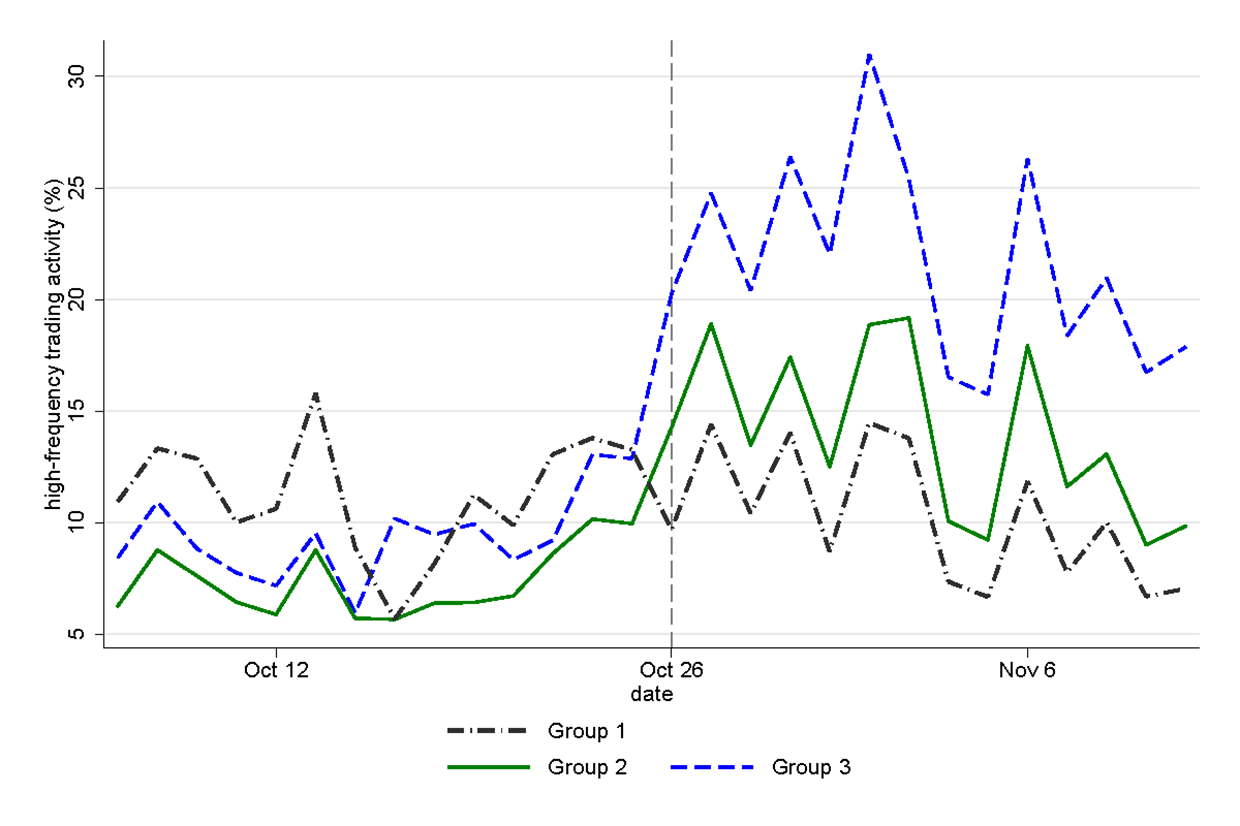
Note: This graph depicts utmost-frequency trading activity about the Federation of European Securities Exchanges (FESE) check off size reform on 26 October 2009 as a percentage of all trades across three groups of stocks: (i) stocks whose tick size was not affected away the straighten out (broken-stippled line, Group 1), (ii) stocks whose relative click sizes are above the pre-reclaim minimum (solid line, Group 2), and (iii) stocks whose relative ticktock sizes are to a lower place the pre-rectif minimum (dashed line of business, Group 3).
I then study how market liquidity changed in these deuce-ac groups. Developments in Group 2 are preachy about the effects altitudinous-frequency trading activity may wear liquidity. I line up that securities industry liquidity built or stayed the like. By contrast, developments in Group 3 are informative about the personal effects greater high-frequency competition may wear liquidity. Victimisation a variety of grocery store liquidity measures, I recover that liquidity deteriorates significantly in Radical 3 despite an accompanying increase in high-frequency trading.
Why does liquidity deteriorate? I witness that, when HFTs compete, they use more speculative trading strategies, which harm liquidity. Specifically, I find that competing HFTs trade on the same side of the grocery in about 70% of cases when looking at five-minute intraday periods. Speculative high-frequency trading increases by about 12 pct points from about 29% to 41% of all high-frequency trading. This is in line with the a priori literature discussed above.
Conclusions and policy implications
To render to our initial oppugn: does securities market liquidity deteriorate when HFTs compete? The results suggest that rival among HFTs increases speculative gamey-frequency trades, which could lead to a declension in market liquidity.
My results chip in to the on-going debate on the benefits and costs of squealing-frequency trading action. On the one side of the debate, HFTs argue that they contribute to Leontyne Price discovery (prompt reflection of news in market prices) and provide liquidity to the securities industry. On the other lateral of the debate, high-frequency trading critics view the vast investments by HFTs into speed infrastructure as a waste of resources, with potentially inauspicious effects on market functioning. My results suggest that markets should be designed in a manner that prevents competition among speculative HFTs and instead encourages market-making HFTs. One concrete suggestion on how to break the adverse personal effects of competition among HFTs was stir by Budish, Cramton, and Shim (2015). They propose to move inaccurate from continuous trading, and instead make discrete trading on, for example, one-second intervals.
References
Budish, E. B., Cramton, P., and Shim, J. J. (2015), "The high-frequency trading arms race: Frequent batch auctions as a market design response", Quarterly Journal of Economics 130 (4), 1547-1621.
Breckenfelder, J. (2020), "Competition among high-frequency traders and market quality", ECB Working Report 2290.
Hagströmer, B. and Nordén, L. L. (2013), "The diversity of inebriated absolute frequency traders", Journal of Business enterprise Markets 16(4), 741-770.
Meling, T. and Ødegård, B. A. (2020), "Tick size wars, HF trading, and market quality", SSRN eLibrary.
Menkveld, A. and Zoican, M. (2017), "Postulate for speed? exchange latency and fluidness", Reexamine of Financial Studies 30, 1188-1228.
O'Hara, M., Saar, G. and Zhong, Z. (2019), "Relative tick size and the trading environment", Review of Asset Pricing Studies 9, 47-90.
Yao, C. and Ye, M. (2018), "Why trading quicken matters: A tarradiddle of queue rationing subordinate price controls", The Review of Financial Studies 31, 2157-2183.
trading strategy for 2 month trading competition
Source: https://www.ecb.europa.eu/pub/economic-research/resbull/2020/html/ecb.rb201215~210477c6b0.en.html
Posted by: heringcootont.blogspot.com
0 Response to "trading strategy for 2 month trading competition"
Post a Comment